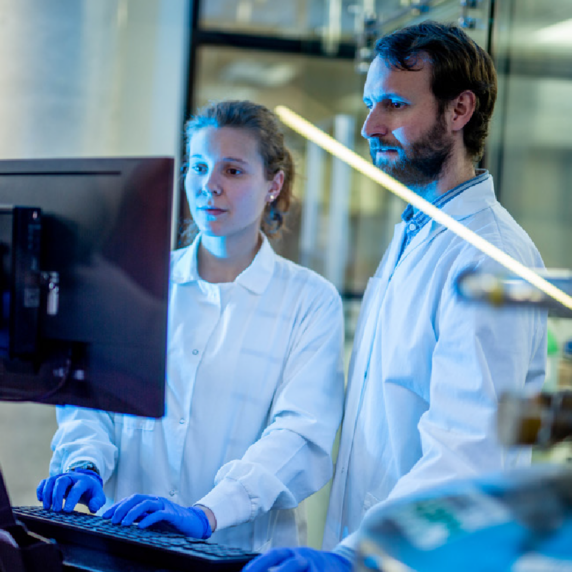
21st century defence: Science, cyber, engineering and tech experts will defend our sovereignty
November 27, 2025
By: Gabriel Miller, President and CEO, Universities Canada
This op-ed was published in The Hill Times on November 19, 2025.
Prime Minister Mark Carney’s first federal budget sets an ambitious course to build Canada strong — devoting roughly 42 per cent of new spending to sovereignty and security and charting a path to invest five per cent of GDP in defence by 2035. This marks the largest commitment to national security in a generation.
Canada’s challenge is turning that spending into modern military strength. Ships, satellites and cyber defence systems won’t keep us safe without the talent to develop, run and maintain the technology. Our ability to defend the country now depends as much on scientists, engineers and innovators as on soldiers and hardware.
Delay is no longer an option. The assumptions that once anchored our safety have evolved. Wars in Europe and the Middle East, rivalries in the Arctic and the Pacific, loss of trust in our largest trading partner and a global race for control of advanced technologies have ended the long-held belief that geography and our relationship with the United States are sufficient to protect us.
Universities are central to strengthening Canada’s defence capability, from developing vaccines that protect troops and civilians during global outbreaks, to advancing clean-energy technologies that reduce military supply-chain risk, to supporting Arctic communities that anchor our sovereignty in the North. Engineers, analysts and cybersecurity specialists are as vital to national security as pilots or infantry.
In the twenty-first century, defence and sovereignty are defined as much by our capacity to withstand global shocks as by the strength of our military. Protecting Canadians means ensuring the security of our energy systems, health infrastructure and northern communities — all of which are now front lines in national defence.
Yet, the Canadian Armed Forces face a shortfall of more than 14,000 personnel, and the deepest gaps are in the roles that define power today, including artificial intelligence, robotics, quantum security and cyber operations.
Addressing those gaps will require a national focus on talent. That is where Canada’s universities come in. They train the scientists, engineers and cybersecurity specialists who are advancing dual-use technologies such as AI, quantum and advanced materials, fields that serve both security and economic well-being. With the right support, connecting academia and industry can accelerate practical defence solutions, create quality employment opportunities, and expand a more effective skills pipeline.
Canadian universities are already leading this work. From quantum breakthroughs at the Université de Sherbrooke, Simon Fraser University and Toronto Metropolitan University to nanotechnology advances at the University of Alberta, researchers nationwide are developing the talent and technology that modern defence demands.
To build on that momentum, universities need stable funding and stronger coordination with industry and government. The creation of BOREALIS is a chance to do both — linking labs, firms and public agencies to move discoveries from research benches to real-world deployment. With the right support, it can expand economic opportunity, create skilled jobs and give Canada a coherent strategy for building its own defence capacity. Strengthening Canada’s defence capacity means building pathways to high-skilled, high-purpose work that keeps talent — and security — at home.
The country’s drive to increase our defensive capacity can also provide good-paying, purpose-driven jobs for Canadians. Maintaining our technological edge in areas like cybersecurity, quantum and AI, can lead to meaningful work that strengthens the nation. Universities are ready to partner to train the next generation with the skills needed to advance new technologies to better protect our sovereignty.
Our allies already understand that national security begins in labs and classrooms. The United States, United Kingdom, and Australia pour resources into university and industry research aligned with defence priorities. Canada has the foundations through Defence Research and Development Canada and academic partnerships, but to stay competitive and secure, we must scale up and connect these efforts through the government’s forthcoming defence industrial strategy.
The government’s decision to boost defence spending is a vital step toward strengthening Canada’s security. But lasting capability requires the people, training and innovation that turn investment into readiness. Canada’s sovereignty now rests on three commitments: the money we invest, the people who serve, and the innovation we develop. Universities are where those three meet — and where investment, ingenuity and purpose become our strength.